
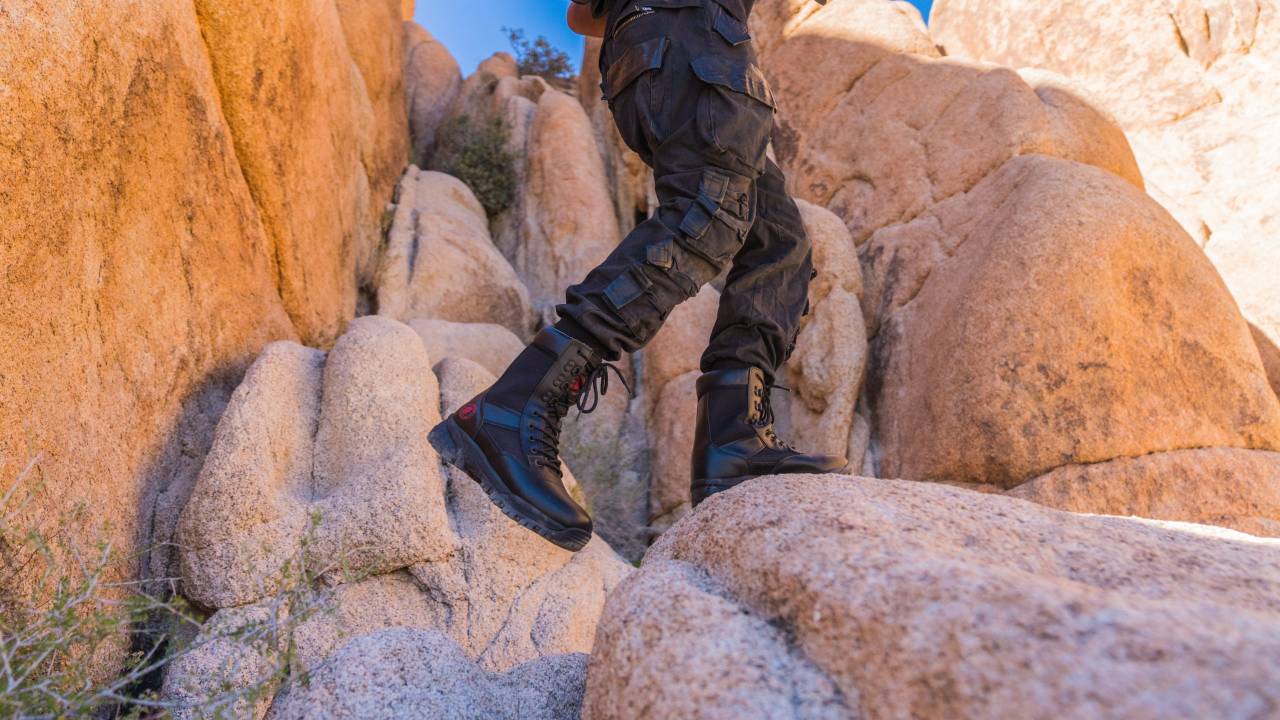
Comfort Memo®: What the Anti-Fatigue System Actually Is
Comfort Memo® is a three-layer anti-fatigue system built into a boot: two layers in the footbed, one moulded into the sole. It is not a drop-in insole, and it is not a single material with a name attached. Calling the whole system “memory foam” accounts for one layer of three.
The distinction matters because our catalogue carries two different products. The RC930 replacement insole is a footbed bought separately: memory foam, dual-zone PORON® XRD® pads, a moulded arch cradle, COOLMAX® on top. It has no sole layer, and it is described on its own page. An insole changes the surface the foot rests on. It cannot change what happens between the ground and the boot.
The three layers
Memo-Top. Slow-rebound polyurethane, 2.0 mm, 0.18 g/cm³, Shore 30C. It softens at body temperature and takes a shallow set under the heel and metatarsal heads over the first weeks of wear, which spreads load across more of the sole. Recovery is deliberately slow: a faster foam feels livelier in the shop and less settled by the fourth hour.
Arch-Grid. Variable-thickness TPU at Shore 60D: 2.5 mm through the centre, 1.2 mm at the edge, formed from hexagonal cells of 4–6 mm. The arch form is modelled on a 28.5 mm male arch and a 26.3 mm female one. It is not a cushion. It holds the arch where it started the shift, so the plantar fascia is not loaded continuously as both ligament and spring.
PUR-Rebound. Dual-density polyurethane moulded inside the sole: 0.35 g/cm³ at the heel, 0.25 g/cm³ at the forefoot. Both densities go into one mould in sequence, so there is no glued interface to separate after a wet month on site. This is the layer that cannot be bought separately, and the one that makes the system a boot specification rather than an accessory.
The layer breakdown covers thicknesses and hardness scales in more detail.
Five zones
| Zone | Hardness | What it is doing |
|---|---|---|
| Toes | 35C | Room to spread; 15° toe spring takes work off the toe joints |
| Metatarsal heads | 40C | A 1.5–2 mm recess moves the pressure peak off the ball of the foot |
| Forefoot | 45C | Low-density PUR returns quickly at toe-off |
| Arch | 60D | The TPU grid holds height |
| Heel | 55C | High-density PUR deals with the landing |
C and D are different Shore scales. 60D is not twice 30C, and reading the two as one gradient leads to the wrong conclusion. The arch is the only zone built from a rigid engineering material; the rest are foams with separate jobs.
What the name does not cover
Comfort Memo® says nothing about the toe cap, the waterproof membrane, the outsole compound or the slip marking. Those are separate specifications and they stay separate. A boot with an anti-fatigue build can still be the wrong boot for live electrical work, for a wet tile floor or for a site that requires a puncture-resistant midsole. Start with the protective marking, then read the comfort build. The features glossary, the SRC marking note and the EH/SD distinction cover the first half of that decision.
On the name and the patents
Comfort Memo® is a trade mark used for this construction. Patent applications covering parts of the sole process, the grid and the zoned build have been filed; we refer to them as applications, and we do not describe the system as patented. A trade mark and a patent are separate rights, and neither one is a performance claim.
Where to go from here
The rest of this series takes the system apart one question at a time: what actually tires a foot on hard floors, how the three layers are built, why PU, TPU and EVA are not interchangeable, which build suits which shift, and how to check a performance claim.